Saturday, 31 January 2015

Risk and reward in game design

We've all been there before; committing to choice. These are the moments we remember as being the big decisions we took. Whether its in real life or in a game, risk and reward is about gauging good and bad outcomes against one another, killing you with worry and excitement at the same time.

Judging from the emotional roller-coaster I've just described this phenomenon as, you can imagine how powerful a tool it is, to anyone working with game design. From the designer's perspective, it's all about understanding what's important to the user at each moment, then using that knowledge to present an opportunity:

  • Win and we'll reward you with important stuff. 
  • Fail and we'll hit you where it hurts - because we know what matters and we'll take that away from you.

Arnold knows so, too

What's important about risk/reward in this sense, is that taking the risk is optional. It is in having the choice, that the choice lies. It might sound silly, but if there is no choice to not partake in a risk/reward event, then it is not about risk anymore, but an inevitable, random event, that might have a negative outcome.

Doing anything like the above paragraph, is bad for the experience: In removing the choice to participate, we restrict the freedom of the users, which overshadows the value of a potential reward.

But as you can probably tell, knowing about risk and reward isn't worth much, if you don't know how to emulate value in your product. A reward as well as a failure, should have an impact on the experience. The bigger the positive impact, the more value and vice versa for failure. But what's valuable, per definition? 

Today's tune:
Before we get to that, here's the usual music that you can choose to have playing in the background as you read. I chose this one because it's still winter, but we've hardly gotten any snow where I live. That makes me a little sad, it's almost like I'm not living in a Nordic country. Had none during Christmas either. Oh well, there's always another year:


Risk and value:


As a rule of thumb, there are two factors that determine value in a fictive environment: Scarcity and usability. We commonly apply both of these factors when dealing with currencies, but mostly only usability if we're dealing with new mechanics, that changes how the users can interact with the environment. However, scarcity may also be applied to mechanics in a multiplayer environment. For example: In Elder Scrolls Online, vampirism and lycanthropy (two new skill-lines that the users can acquire), have a high usability, but thanks to the way you acquire them, also a measure of scarcity. They're not easy to attain, and so therefore that has some inherent value.

But what about risk? What's interesting about risk, is that the possible failure it implies, is the polar opposite of reward. Instead of gaining potential, you loose it. We can use our measurement of "what is valuable," to determine what we can impact as designers, to make the users feel it negatively.

For example; in a game where you don't heal automatically, it suddenly becomes a much higher risk if you loose health upon failure. This wouldn't have nearly the same impact in most modern games, where you simply recover after a short period of time.
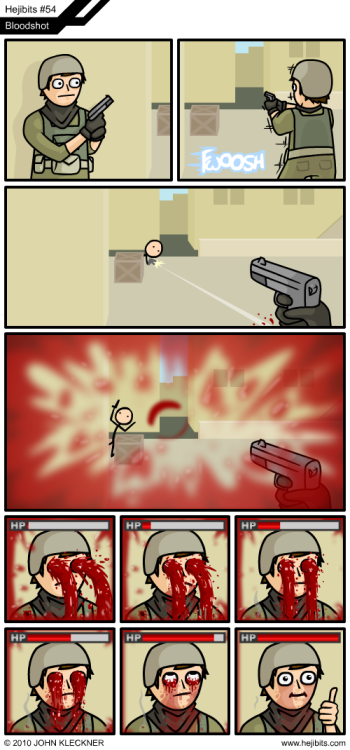
Always remember to ingest your regenerative nanite-paste, kids!

What you should be really careful with, when dealing with loss, is the loss of mechanics. The reason for this, is that it moves the users into a mental space of disempowerment, which may lead to frustration: Taking away control, is bad. This can be accommodated for, by making it a recoverable loss. However, it's very important that the recovery depends on actions performed by the user, rather than time. Using time as a recovery factor, instead of actions, would make the loss as inconsequential as loss of health with auto-heal on.

Another big problem with time, is the pacing of the experience. If you make time a factor, you punish the users who have a faster progression rate, than the ones who wait. This adds a measure of artificial lengthening to the experience, which can be felt and will most likely put off the users. If you base recovery on actions - such as paying ingame currency for your recovery (very simple example, not a good go-to solution) - you accommodate for different paces of progression and skill.

The pitfall of imbalance:


While working with risk and reward, it is extremely important that your reward makes it worth to consider, in light of the risk you take to attain it. If your experience ends up being about "normal progression or failure" rather than "significant progression or failure", then the users get what I like to call the "every-god-damn-time"-syndrome.

If a tester makes this face after failing, back off two paces before asking questions.

This syndrome owes its existence to how our brains deal with memorability. We've dealt with novelty in user experience design before, but the memories that stick are not filtered for what's good and what's bad.

What that means, is that if your risk/reward scenario ever cooks down to "regular progression or failure", it's the failure that becomes the novelty in your design. If we don't fail in such an encounter, we won't pay any mind to it, because the result doesn't stick out. Unfortunately, the opposite is true if we fail. Which means that since we only notice the encounter when we fail, we'll feel like we fail it every god damn time, even if we've only failed a few times.

Risk and reward as a narrative tool:


Risk/reward is an extremely common element in any game that is aware of its users' basic psychological urges. A good roleplaying game is about being presented with choices, that aid to reinforce your feeling of being "in character" throughout the narrative. All users have some kind of ideal personae they want to enact in the game-world, and having choices that support the fundamental personality-traits of said personae, helps heighten the immersion.

Therefore, the best roleplaying games are riddled with choices. But a choice is basically a commitment and an exclusion: Pick this and you can't pick that. Anything that you can take apart and fit into those two boxes, can be twisted into some format of a risk/reward decision.

That means risk/reward is not always about statistics and difficulty. Sometimes it's just about making a decision in a narrative, and the risk lies in getting an undesired narrative outcome. The reward is, as follows, getting the desired narrative outcome. Of course, the biggest impact comes from when the user is the most immersed in your narrative. At that point, their heightened empathy means that they evaluate the choices as if they occurred in real life - making for some very tense moments, if done right. Which is why using story elements (if done right) is just as effective as tweaking numbers and mechanics as the outcome.

Rounding off:

Let's summarize:
  • Risk and reward gives weight to optional choices.
  • Reward only means something, if you can emulate value properly.
  • Value is a subjective measurement, it is not inherent in mechanics and coin, but can be about story too!
If you want some more hands-on examples, keep on reading!

__________________________________________

Risk and Reward in games today:

Now we know what risk/reward is. But how is it commonly applied in games today? Interestingly enough, it is mostly present in a genre that has been resurrected over the past few years, after being "dead" for ages: Roguelikes.

I'll summarize what a roguelike is, to those of you who don't already know it: A "roguelike" game, per its original definition, contains procedural level generation, permanent death, turn-based gameplay and tile-based graphics. Today, however, it's a bit broader than that, as modern roguelikes tend to be more about the "permadeath" in the context of modern mechanics, instead of only being tile- and/or turnbased.

Imagine a board game about punching each other.

The core of roguelikes is, when isolated, about the random elements and the permanence of failure. Typical in modern roguelikes, there is an element of persistence across each attempt. In other words; the more attempts you've made, even if failing, the further you've likely made it into the game. It rewards you with a permanent bonus, if you make it far enough, that persists even if you "die" and start over. This is done to appeal to a wider audience, who prefer to feel that their every attempt matters.

"FTL: Faster Than Light":

A roguelike that comes to mind when talking risk/reward, is a game called FTL. This game is so full of both choices and random elements, that the odds of you getting two identical playthroughs, is almost nothing. But the risk/reward choices are what's important here.


FTL is all about traversing an area; or travelling a branching path if you will. Along each segment of this path, lies an encounter. An encounter is essentially a small board on its own, that contains an event. Sometimes you are forced to fight, but you are often given a choice:

Something obviously risky is happening!

  • Partake for the potential benefit, facing the massive risk? 
  • Or skip out and let go of any rewards that could have been?

What's so brilliant about these choices, in the context of FTL, is that the game forces you to move forwards all the time. Unlike common roleplaying games where you can stay in an area until you feel powerful enough to move on, here you will be killed if you do not move forward.

This setup forces you to consider both the risk of partaking in the event, as well as the risk of not doing so, as not having the potential upgrades from a successful encounter, will make the game incredibly hard later on.

That causes the game to have an absolutely brutal difficulty spike, as the pacing of the user has to be fast enough to not fail. Yet the luck in the randomization is enough to keep most people going, as "maybe next time I'll get lucky!"

Even though I have no idea what I'm doing.

Homework:

This is something I'll start doing from now on, which is to give you - the readers - something to do, in order to try to apply some of the theory you've learned here. It's not something you'll have send, as it's for the sake of your own learning. But if you feel like you need some feedback on it, feel free to comment on the article that the question relates to.

The assignment this time:

It's quite simple. I want you to find a roguelike and try to analyze it: Identify when you are set in front of a risk/reward choice. The reason I want it to be a roguelike specifically, is because the risk/reward choices are often inherent to games in this genre. However, if you know of any games you know displays a similar nature in choices (believe me, there are many), by all means; go ahead and analyze that as well.

Here's a bit of inspiration, if you have no idea where to start (don't worry, they're not all ASCII-based:


Once you've found a few examples, and feel comfortable enough in remembering the theory from this article, try looking at games that are lacking a risk/reward choice system. Then think about how such a system could be implemented. I recommend you really take a close look at what elements of the game matters most to the players, then consider how said elements could be rearranged to create some risk/reward choices.

Have fun!

~ Dave

Monday, 19 January 2015

Working with the fear of missing out - The Elder Scrolls Online special.

Time for another game design article! This time, I'll talk about a topic that is very relevant in modern society, which is the phenomenon of "non-commitment." It essentially means "when a person never commits themselves to a particular choice, so that every option is perpetually open to them." This time around, I'll be using The Elder Scrolls Online as my prime example for a good solution.


As  usual, I'm going to start off the article with a bit of reading-music, for those of you who like a backing track to your studies. As we're doing a bit of an Elder Scrolls special, I thought it fitting to use Jeremy Soule's music this time around:


A few generations back, it used to be that you grew up to take over the job of your parents, but now you have to choose for yourself. The choices (if you live in Denmark, at least) are virtually endless. But what does that do to our minds, when we're suddenly granted such an important responsibility to commitment, yet so many choices?

As you might have guessed from the term "non-commitment", people tend to suspend themselves, never being able truly commit to one thing: Committing themselves to one choice, is synonymous with letting go of another. This is true whether the individual acknowledges it consciously or subconsciously. It is the fear if missing out that keeps them suspended.

Unfortunately, this idea of suspending oneself in the choice of not making a choice, is a really massive flaw in our psychology: Time passes no matter what we do. However, most people grasp time entirely from a subjective standpoint, when they evaluate its passing (see "How to Christmas spirit" for a more in-depth explanation of the subjective passing of time). Yet you'll miss out on everything if you do not commit yourself to something.

Now if only I had a time machine to demonstrate it with.

To turn this in the direction of game design, many games are based around a series of meaningful choices. Whether its a moral choice, picking a character-class or choosing your companions, the choices are there. Mind that the problem only seems to persist in games, where the users are aware that they need to spend a lot of time dealing with the effects of their choices. This is very common in role playing games, particularly MMOs, or any other game where your choices will be reflected in your experience for a long period of time.

More casual titles do not tend to suffer from these issues, as they only require user interaction for a small period of time, or contain no significant choices.

The theoretical stuff:


In a well-designed game, the users quickly commit themselves to their choices. They do this much more confidently than they would ever pick something in real life - like when they have to choose a career path.

Oh god, the red beans are forming a worker's union!

But why is the virtual world so different to people?

The simple answer is: The games that make people behave this way, knows how to treat their users with care. It used to be that games could be extremely complex to boot, yet you'd still find a fair share of users enjoying the process of understanding the whole system. These people still exist, but the size of their audience is dwarfed in comparison to the younger ones, who suffer from having suspended themselves in this "choice limbo" in real life. That forces us to evaluate how we can include the bigger group, without letting go of the complexity that the smaller group has grown to love.

The most common way to tackle this issue, is through tutorials and procedural introduction of content. You can still make advanced systems, if you just introduce their individual elements one at a time; If you give people one piece at a time, they always just have that one new piece of information to reflect upon. If they have more than one new piece to deal with at once, they might overlook the functionality of one of them.

But as long as the users feel competent enough to make projections about what causes what, your design is generally in the safe-zone. When evaluating if your users can grasp this "action/reaction"-relation in your design, think about whether or not all of the game's elements have been presented in an isolated instance, before used alongside something else.

Another way that many games deal with the issue of indecision, is simply by letting the users have it all. Unlike real life, games are often a tangible, limited whole. If you just feed the users one piece at a time, they'll eventually have passed through the entirety of your system, never having had to make a choice in the first place. A lot of people will call this "too much hand-holding," however, and it will make for an very linear experience. What we want to know, is how we can let the users have these complex choices and be able to deal with them as well.

I don't think an explanation is necessary.

Again; to really overcome the problem, you must design your system to segment the experience into separate, tangible pieces. Every interaction that occurs, must first occur on its own, before occurring in tandem with other interactions. Use this as a rule of thumb, if you ever want to introduce something new.

However, even as we take these precautions to make sure that people understand the individual elements, the real danger lies within having too high a density in "the number of impactful choices that occur at the same time, at any one point in the user experience." When ascertaining impactful means, we need to look at it subjectively. Something that has impact, is something that behaves unexpectedly:

When a user is faced with multiple choices, where the outcome of each is relatively unpredictable, we observe two simultaneous negatives occurring within the mind of the user:
  1. I don't know enough about this choice to commit myself to it, as the effects are uncertain.
  2. I don't know enough about the other choices to exclude them from my personal interests.
If the users ever establish this kind of relationship with a set of choices, they are going to fatigue, eventually. Many people, after committing themselves to a choice made with the above points in mind, will also be in a constant state of curiosity and regret that they did not choose the other, thinking "what if." This can arguably be used as a driver for replayability in some games, but it might be bad in very long-term experiences that require commitment for the users to truly experience the game's content properly (namely MMOs).


Hold on to your hats, because here's a theoretical explanation of how you should look at user-progression in your game:

You can ensure the integrity of the flow of the user-experience, by examining it as a chart of occurring instances of choice, as well as weighing the importance of each choice, based on previous exposure to similar choices - or exposure to the possible consequences of said choices, before committing to them (in other words, telling the user that; "doing this may/will cause that to happen"). This enables you as a designer, to see where an overload might occur, where the user doesn't know what to commit themselves to, because they lack information.

The practical stuff:


That got really convoluted, so here's how you should do it in practice: 

It can be done very simply, by making a flow-chart of possible user progressions through your system's environment. By listing everything that your users have been exposed to through certain paths, you force yourself to recognize when new elements are introduced. You can even do this with completely non-linear sandbox games, simply by looking at how a character might evolve through its interactions with the environment. Just ask yourself "what can the user possibly do at this stage?" and write the answers down as connected bubbles in a flow-chart. This will help you visualize what elements of play are relevant when.

You can go a long way by examining your game this way, but you will only really know the outcome of your design, once you've tasked a group of users - over time - to gauge their experiences. But an even more effective way to get the information you need, is to data-mine how many "do-overs" each user has: Did they quit without saving? Do they have multiple saves on the same character? How many characters have they made? Did they reset their progress and at what stages did the resets occur? If things like these are happening often, your users might be suffering from non-commitment, and so they might quit half-way through.

And often discover things you weren't even looking for in the first place.

The biggest problem with overcoming non-commitment as a developer, is that time is such a big factor. And to make matters worse, users will often not suffer from this problem if they know that they have to start over anyway, when the game is released. Offering some form of persistence through the testing and into the final release, could help alleviate this issue.

Example-time!


Now we've spent a while talking about the problem and how to approach it, so I believe it's time we take a look at some existing solutions. This time in particular, I am taking a look at The Elder Scrolls Online (I'll refer to this as TESO from now on). While we won't be looking at what design-processes were used to create these systems, we will take a look at how they affect the user experience.

Respeccing:


So what does TESO do, to deal with these issues? Let's begin by looking at a very simple example, which is not uncommon in role playing games: "Respeccing."

If you've never heard of respeccing before, it means resetting your character's progress, while reclaiming the points you've invested. In other words, if you've spent 5 skill-points on skills that you no longer want to use, respeccing gives you those points back to be reinvested elsewhere. This means that the users always have this mental concept of "my choices have consequence but are reversible," granting them the freedom to experiment.

The average user-experience when starting a new game.

However, TESO takes this one step further, by having three stages of point-implementation and respeccing, instead of just one.

You see, while it is typical of role playing games to have two separate types of points for character progression (the second being attribute points, which typically affect certain statistics on your character), TESO introduces something called "skill morphing." A skill morph is an upgrade, that adds extra mechanics to your existing skill. To attain a morph for each skill, it requires an additional skill-point, and the original skill has to have been used for a moderate amount of time. This is brilliant for several reasons:

In terms of respeccing, the system can be broken up into three parts. While some games require you to invest a hefty sum of gold to reset everything, TESO lets you choose whether you want to reset your attribute-points, all of your skill-points, or just reset your skill-morphs for way less gold.

This means that for every step of personal commitment that exists in this system, there is an action to reverse it.

Now I can get my skillpoints back AND afford wizard-college!

The only exceptions to this rule would be when you choose a class (which is irreversible), define the anatomical features of your character, pick an alliance or perform certain moral choices in the story line. But if you consider the fact that people can have several characters on the same account, you'll see many of these issues - if not solved - marginally alleviated.

The second reason while this system is so brilliant, is thanks to the mechanic; that skills have to be used for a certain amount of time, before unlocking the morph. This forces the users to come to terms with how the skill works. Once you've actually reached the point at which you're asked what you want to morph your skill into, you've already come to terms with how you prefer using it. This makes it much clearer what the different morphs can potentially add to your play style, making the choice easier.

Multi-role classes:

Now here is something that I really like about TESO. Although picking a class and a race, locks you down with a certain pool of skills to choose from, the game itself is completely open with what items you can interact with and use. Which in turn means that every class can essentially fulfill any role in a team.

If you're not familiar with the classical roles in role playing games, they are typically sorted like this:

  • Damage dealer - specializes in dealing as much damage as possible
  • Tank - tries to take the punches for everyone else, as a buffer
  • Healer - keeps everyone alive, especially the tank

That's the typical assortment. In most role playing games, picking a class would often lock you into one of these roles. This means that before you choose, you have to already have some idea of what your preferred play-style is. But in TESO, you are allowed to discover your play-style through experimentation. Any combination of existing elements in the trio above, is possible, regardless of your choice of class and race.

Lightning-powers and a giant hammer? Yes sir.

With a system this dynamic, we remove a lot of the pressure and consequences that such an early choice would otherwise carry with it. And by letting the characters become good at everything, if they spend enough time practicing, it shifts the choice from permanence to being a question of investing time. This is something that people can handle much better, because they miss out on much less. While some combinations of classes and roles might fare better than others, the fact alone that the possibilities are there, really helps defeat non-commitment.

The champion system:

This system is not actually in the game yet, but the premise of it is so closely tied into this article's subject, that I just have to include it. I'll start by outlining the system itself:

Originally in TESO, once you reached level 50, any level gained afterwards would count as a "veteran rank." Veteran ranks are essentially like character levels, but harder to gain and give a much more significant boost to your character's attributes. But now veteran ranks are on their way out.

To replace them comes the champion system. Now, when you reach level 50, instead of gaining veteran ranks, you gain champion points. These points are spent in the champion rank system, to advance your character. This is where it gets really interesting:

The champion system consists of a total of nine "pools," each containing passive skills for you to invest your points into. But these nine pools are separated into three major categories, each containing three of these pools each. These categories are thematically reflecting the three major attributes in the game:


  • Magicka
  • Health
  • Stamina

Whenever you gain a point - and this part is very important - it will be dedicated to one of these categories. This happens in a cycle: If the first point you gain is locked into the Magicka category, the next one might be dedicated to the Health category, while the third one would then be dedicated to Stamina, before starting the cycle over.

If only real life skills were colour-coded.

As you can see in the illustration above, there are the three categories. The genius of this structure and the way you have to cycle through it, is that it focuses the decision-making process of the users to the individual categories.

If we look at the categories individually, we have the three pools contained within. Each of these pools are segmented into three tiers - each tier containing a number of passive skills. In order to unlock the next tier in a pool, the user will have to spend a certain amount of points into the previous tier. This segmentation further helps with the decision-making, simply by restricting access to a certain tier early on.

Combine the three primary categories with the tier-progression on the individual pools, and you make a very "easy-to-think-about"-system that entices the users to cut loose and experiment. And you can still preview the later tiers, letting the more advances users plan ahead - you just can't invest in them right away.

To top it all off, points earned in this system are account-wide. However, the points spent are only spent on the individual characters (they are still available for other characters to be used differently). This means that you can invest your points with a complete disregard for whether or not it benefits your other characters, once again leaving you with one less thing to worry about.

Preventing this from happening.

While this system was designed to balance user progress, you can clearly see how this ties into helping against user indecision and non-commitment. But one of the primary reasons that the system is as viable as it is, is the fact that it only becomes active when people have already reached the maximum level.

This way you can describe what the skills do in a very concise way, as we can suddenly rely on the users knowing a great deal about the system already. Concise information is very important when you want to ensure clarity in your communication, so the fact that we can cook the info down to not contain further explanations, helps the decision-making process even further.

Rounding off:


Alright, time to summarize what we've learned:

The world is changing, and these changes affect us. The fear of missing out, causing non-commitment to significant decisions, is a pretty big issue to recent generations in the modern world. But while it is problematic when it comes to real life decisions, we can use it as a force for good in game design.

By knowing what triggers these issues, we can look at what equates the opposite and use that in our design. In this case, segmentation is key. The most important thing to consider, is where the "mental frontier" of a particular user might be, when they perform certain interactions within the system. What this means, is to look at previous interactions, so we can make assumptions about the user's current understanding. 

 Realizing what the users know, helps us on two different fronts: It helps us cook down the information we deliver to an "as-needed" basis, but also makes us realize from a development standpoint, if there are any potential holes in the knowledge of the users, which might otherwise be required to understand what is happening at specific moments in the user-experience.

If information is missing, we have to present it in an isolated instance, before representing it in a broader context.

When we have ensured that our design adheres to these rules, we must always examine the amount of possible interactions that can occur at the same time. If too many options are presented simultaneously, the indecision kicks in. Information and interaction density are the two primary rules we must look at, to prevent non-commitment-driven user behaviors.

Keep in mind that a very large, complex system can still exist - just as demonstrated by TESO. But then you must present your content in bits and pieces, in a sequence that plays on information that has previously delivered.

Defining user information:


Now I've mentioned "what the users know" on several occasions. Mind that this refers to "what you have previously told the users, through interactions with your systems." Do not confuse this with what we can assume certain cultures to know beforehand. While culture is still important, as long as you design for an audience that has the same cultural background as you do (the western market, in my case), you can inherently make assumptions from your own experiences. 

But knowing your target audience is a whole topic in its own right, so we'll leave it at that.

Bonus video:


What's an article without a little extra inspiration. Here's a short video about the fear of missing out, for you extra curious people:


Sunday, 28 December 2014

How to "Christmas Spirit" - An essay on novelty in user experience design.

Since it's December, I thought it would be fitting to make an article about how to get in the Christmas mood (or "spirit" as it's commonly called). Coincidentally, utilizing the psychology behind getting in the right mood, is also common in good game design. So let's make this a holiday special, where I will explain the concept of "Christmas spirit" with user experience design theory!

Hopefully you'll be able to design the perfect holiday season for yourself, after learning what it's really all about. Which isn't necessarily to buy yourself 200+ new games during Steam's holiday sales (but that's not to say doing so, isn't going to help).

Just as the great Gaben Claus would have it.

I'm going to start out with a slightly cliché'd, but very important topic: The pursuit of happiness.

Being happy is something we all want, as much as we can get it. Almost all of us build our lives around what we think will make us happy. But strangely enough, hardly anyone has any tangible concept of "happiness," other than a gut feeling. So when we say "I want to be happy," we don't really know what we're talking about. This is a big problem, because "being in the christmas spirit" is quite simply a variant of "being happy." The only difference is that "christmas spirit" relies on certain factors, which are only present at one time a year.


Defining "happiness"


The subject itself seems pretty touchy-feely at first glance. However, it can be explained in a very elegant way, which has been done very eloquently by Jason Silva in the following video:


Now we are beginning to understand. In our pursuit of happiness, we loose sight of what it is that we are actually looking for, which is novelty. And novelty is something we can work with - both in game design, as well as when it comes to planning our holidays.

Identifying the problem


But what happens when things don't go as planned, and there is no sight of any christmassy gut-feelings throughout the entirety of December? We need to examine this, before we know how to counteract it:

December begins, December happens, December happened. But no Christmas spirit in sight. How on earth did that happen? I'll outline the problem shortly, before we open up the "aha" box:

You expect to get in the right mood, just because the season is there. However, the anticipation is gone, and your days are still about participation in monotony: You do the same things every day. No dedication, just the passing of time and the silent wish that maybe, perhaps tomorrow, you'll suddenly burst out into a huge smile and start humming jingle bells and swimming in glögg. Yet however long you wait, it doesn't happen. So you start blaming things like "no snow, no interesting calenders to watch, same as last year bla bla."

Before you know it, you'll resort to doing crazy things like putting Santa-clothes on your dog:

Who will inevitably kill you in your sleep,
before proceeding to give you "coal" for presents.

Ladies and gentlemen, we can do better than that. We now know that the experience of happiness, relies so heavily on novelty. So we can begin to consider ways to work novelty into our design.

The Christmas spirit "cheat-sheet"


We can skip through a whole lot of trouble trying to identify this issue, because we've already experienced being in the mood we seek, before. Most of us, as kids, have memories of having a very merry Christmas. All we have to do is recall those memories, then analyse them.

I'm going to use myself as the template, seeing as I know no person better. So here is what was going down, back when I was a little doodle-poop. Remember that I am only talking in terms of what personally gave me the Christmas-jitters:

The anticipation


Holy shit, the anticipation. Never was there a time of year, besides from on my birthday, where I was more excited about stuff in wrappings. This was one of those things that were completely defining my experience; just waiting, staring at said wrappings. Sometimes I'd even get so excited, that when the time finally came for me to unwrap my presents, I almost felt that the wrapping was more interesting, than what was inside.

It was almost unbearable when we had to dance around the tree. Always those agonizing 15 minutes, eyeballing my presents every time, knowing that I would soon be experiencing the rush, of learning what was inside.

"Hark the angels- THERE IT IS AGAIN!"

Then there's the 24-episode TV calendars, typically accompanied by a physical cardboard calendar, with each cover revealing a hint for today's episode. That combination was absolutely ingenious, when it came to building anticipation - generating novelty. We'll get back to why that is, in the summary.

Finally, there's the aesthetics. The decorations are hugely important here, in two different regards. Remember that we are using my childhood as a reference frame here, so decorations meant more than just hanging them up; it also included creating new decorations in school. We'd spend a whole day just making things to hang up on the classroom walls and in the hallways, eat Christmas treats and all that jazz. Then until holidays finally started, we'd be surrounded by our work, as a reminder throughout the hours we'd spend in school.

Let's tally all that up and do a quick analysis of why these things mattered (and still do):

My childhood in summary and analysis:
Anticipation is paramount, that much can be said. But the reason it is so, is for the same reason that worry can sometimes consume people; our brains can only process one thing at a time. Anticipation, once properly established, is a constant factor. This leaves little room for much else, so you can imagine how it'll do wonders to your mood.

But how is anticipation manifested, in the examples above?

The presents: With the presents, comes a measure of uncertainty. We're left guessing, speculating, scratching our heads as to what might be in those delicious wrappings. However, this only works so long as we genuinely believe that there is something contained within, which we will appreciate.

This presents a problem, as we grow older and suddenly have cash coming out of every orifice. We're much more willing to spend money on ourselves, than we are buying presents for others. This is logical, since the personal benefit of a purchase for ourselves, significantly outweighs the benefits in buying the same thing for someone else.

Dead trees are my favorite currency!

We then transpose this logic to our level of anticipation, which in turn makes us think that "we can only get something lesser for Christmas, than what we can buy for ourselves." We don't acknowledge this consciously, but it presents a pretty big obstacle when it comes to appreciating what we've got. Our sense of anticipation simply flatlines.

However, regardless of the amount of money we can make, there's still ways to combat this mentality.

Step 1 is simply acknowledging it. Say it out loud, then you'll realize how stupid it is, and this will make you reflect upon the matter.

Step 2 is thinking about the memorability of the gift, rather than its direct applicability to your daily life. In my case, this typically means a good game - be it digital or a boardgame - because I like to observe all the rules of play. This means, when I'm playing, I generate a lot of memories. Since I drink a lot of tea, it might also be a funny cup, which is almost always present.

But we'll come back to memorability in a moment.

What you should take from this, is to really think about memorability, when you write your own wishlist. Christmas shouldn't be about how beneficially you can think, it's about how much of an experience it would be.

The Christmas calendar (physical and TV-calendar): The calendar is really important, when it comes to building anticipation. But this is only when a physical calendar, reveals something about a TV-calendar: Every time you open up a cover, there's a hint for today's episode.

One of the best Christmas months I've ever had, I remember, was when I was a kid watching the "Bamse & Kylling" calendar on TV for the first time, while opening the covers on a huge cardboard calendar, every morning. We only had one calendar for the show, despite being two kids, so we'd take turns.

I try to forget that these are grown men in costumes.

There's several things to take from this. Firstly, there's the fact that we opened the calendar in the morning. This is important, because the show aired in the evening, so we'd be given room for speculation throughout the entire day. Many of the kids at school would also watch this, so it'd often permeate at least one of our conversations in class. This can be hard to replicate, but the point is to not be alone in participating.

If we refer back to the start of this summary and analysis, we recall that our brains can only process so many inputs at once. If you can make these discussions a prominent input, throughout December, you'll most likely see that you can't help it but get in the Christmas mood, as it becomes such a big part of your daily routine throughout the month.

Also, while chocolate calendars are great, you can probably see how they do not provide the same kind of mental stimuli. I still get a chocolate calendar every year, though, because they're as much a part of what I consider to be Christmas, as the decorations are.

Even if you can't get a calendar that goes in tandem with a TV-show, having one with motifs rather than chocolate, still means you'll think more about the content. Getting chocolate, while delicious, boils down to the caveman-parts of your brain craving sugar and fat. That's why some people end up eating all the chocolates early on. Unfortunately, this is a very instinctive reaction, meaning that there is very little sustained attention to what you are doing, in the moment that you do it.

The "persistent touches": Back when I went to (what I think you guys call) elementary school, we'd have one day that was entirely dedicated to making our own Christmas decorations. It was often right before December started, so that we'd be surrounded by the things we'd made, for all the days in the month, that we went to school.

Approximation of how the classroom ended up looking every year.
(including the bar)

On that day, we'd also make 24 drawings to hang up on the wall, each under a cover. This feeds back into what I've mentioned above, with a motif-based calendar. However, with its placement in the classroom, taking up a wall, it also doubled as a countdown.

With a massive countdown on the wall, surrounded by the things we'd made, every day was a reminder of what month it was, rather than a distraction. When I went from home, I arrived at more Christmas decor, rather than simply move away from what was at my house.

The memorability


We mentioned memorability earlier, but what does it really mean? When something is memorable, it's something we've consciously (or subconsciously) acknowledged, as being worth remembering. This happens whether we want it or not, so it can be both good and bad memories. I'd wager a guess and say that we don't want to build this around bad memories, though.

However, in terms of getting in the "Christmas spirit," what does memorability provide?

To understand this, we'll have to look at how we perceive the passing of time. One of the most common complaints about Christmas, is that it went by too fast. Yet if we look at the right here and now, evidently, the world is going at the same pace as it always has. So it can't be because we're literally moving slower.

No, it roots in our memories. All we have is the here and now. However, our notion of "past" relies on the accumulation of memories. The more significant events you can recall, in the shorter the time-span, the slower you'll perceive the time that has passed. When we say "Christmas went by too fast this year!" it's because we've been doing the same thing throughout the month, which collapses into a singular memory - and with it, collapses our notion of time.

Pun intended.

To combat this, we need to deliberately generate memorability in what we do. This can be difficult to tackle, if we don't know much about how our brains work. Therefore, I'm going to tell you what I'll do next year and why I'll do it that way:

Creating a personal calendar: Just like I did when I went to elementary school, I'm going to make my own calendar. I'm not sure if I'll draw motifs for every cover, but I will most certainly have daily activities listed under each and every one of them. This reflects back to what I talked about, with anticipation for the day. But most importantly, it's about deliberately forcing yourself to do things, that are outside of your daily routine.

For me, personally, every day is going to have a reminder about watching today's episode of the TV-calendar (including the time it airs). This matters, because a show is an evolving narrative, with no repetition. While it might not be the big game-changer in enhancing your experience, it will most certainly lay a decent groundwork for memorability each day.

However, doing activities outside of the norm, is also really important. Include some daily routines in your calendar as well, like days you work out, you write "work out" in the calendar. This makes it much easier mentally, to feel like the "out of the ordinary" is worked into your "ordinary," so you don't skip out on Christmas activities, because you feel like they're blocking your workout routine, for example.

You can be both buff and Santa.

What can you do, then? Bake some cookies, make decorations, go on walks in the forest, find out where the most impressive decorations around are located, then visit them. I can guarantee you that there will be a million things to do, if you just research properly or ask around. Or try to do something extra about the things you would normally do anyway. For example, don't just go to the mall and buy a Christmas tree, find a barn on the countryside where they sell them, instead.

A very interesting benefit from making the calendar your personal to-do list, is also the fact that it works as a referential reminder. Every time you look at it, you recall what you've been doing, which helps segment even the similar memories.

Making your own decorations: I don't care how much Christmas decor you already have, make some more! This isn't just for the sake of hanging it up, it's for the fact that the creation-event itself, makes for a very prominent memory. You'll have to sit down and reflect over "what is Christmas-like," then put that to paper/cardboard/whatever you use. When you look at this decor later, your brain will fetch those memories and all the associations you thought about, when you were making them.

If you have way too much decor already (like that's possible), there's no need to make this stuff out of expensive materials. You can always use coloured paper, which you can throw out at new year's.

Just do stuff you normally wouldn't do: Even if it isn't super Christmassy, think about things that could be interesting, which you normally don't do. I mentioned a walk in the forest, for example. Anything that's unique in the sense, that it is not normal for you to do, qualifies. Just make sure you bring something Christmas-related, like everyone wears a Santa hat and you have glögg in thermos.

Sometimes, the outside looks like this!

In the end, it all comes down to overcoming what's called "hedonic adaptation." Which is a fancy way of saying that you should do something, which you have not been over-exposed to before.

Hedonic adaptation can be an issue in more cases than just getting in the Christmas spirit. Here's a general video on why it's a hindrance, and what tackling it might bring. You'll recognize the concept of memorability appearing, as one of the key benefits for overcoming this issue:


I try to work on this every day, but it's also pretty key to getting in the right mood, during Christmas. Making the aforementioned list, is going to help us stick it to the man/our hedonic adaptation, and break with the norms that makes our time-perception a muddled mess.

This also leaves us rounding things off nicely, once again returning to the importance of novelty. It's ok that you do the same things every year, on Christmas. As long as you don't do the same things on Christmas, as you do the rest of the year - at least not do the same things the same way, as you do the rest of the year.

I think that makes it a wrap!

___________________________

Here's a piece of music to summarize my emotions right about this time of year, hope you'll enjoy it as much as I do:


So with that said, I just want to wish you all a (slightly late) merry Christmas and a happy new year!

Sunday, 23 November 2014

Tackling the issue of accidental hostility, in an artificial general intelligence (AGI)

For this article, I'll start out with a quick video-introduction to Artificial Intelligence. You can skip over it, if you're already well familiar with the phenomenon, but it's a great, short video regardless (fullscreen is highly recommended):


There's a lot of talk about Artificial Intelligence. Mostly concerns about the loss of jobs, the potential for the many uses of AI, and the possible dangers that comes along with a new, thinking life-form here on our planet.

Artificial Intelligence, however, is mostly only being discussed, as working on single tasks. This form of AI is merely a tool, made for a specific job, to do it better than any person. What we have still to popularize in public talks, is the concept of Artificial General Intelligence (we'll call it AGI from here on out). While the names are similar, there is a very fundamental difference between AI and AGI:

AGI is built on a very simple premise; to learn. This is unlike a "common AI" (by modern day standards), which is built knowing what it needs to know. But an AGI is like a child, capable of attaining new skills and mastering them as it goes. With this capacity to learn and adapt, it is often said that AGI is going to become our predecessor, or even more interesting; that we will merge with it, as it reaches beyond our own level of intelligence, so as to not get left behind.

Evolution accelerated - exponentially.

Now this is where the controversy spikes. When dealing with such a powerful intelligence, there is always a risk of weaponization by early adapters (most commonly military), as well as misinterpretations of good will. For example: We tell an AGI to eradicate cancer. It then finds out that the most effective way to do this, is to eradicate people more prone to developing cancer. These are the risks that we must try to avoid, at all costs.

While we can't do much about the military, we can do a lot about the latter example. We can't control intelligence directly, so we must look at how it grows. We have to find the early defining parameters, then alter them to make it as little prone to misunderstandings, as possible.

But what is the "genome" of such an intelligence, how can it be regulated?

First of all, we know that an AGI would operate on semantics, when it needs to learn. In modern day machine learning, we employ something called "semantic analysis," wherein which an algorithm can analyse large quantities of data, to look for correlations within. A really powerful AGI would be able to extend itself, by studying repetitions of data-correlations, in spoken language.

I'll simplify with an example of semantic learning: You meet a person, who doesn't speak a word in English. You have to tell said person, that the colour yellow, is called yellow. You point at a yellow hat, then say "yellow hat." Next you point at a yellow shirt, then say "yellow shirt." The person is now quickly able to piece together, that the common element on the two objects, must correspond with the common words. Yellow the colour, is now understood as yellow the word.

A simple semantic network example.

Think about this for a second: Pretty much everything we know, that we want to pass on to others, is in our written tongues. If an AGI can begin extrapolating data from all our archives of information, then apply them in the contextually relevant circumstances, it would instantly be capable of substituting almost any person, at any task.

If our language and all its implied semantic interrelations, are to become the foundation of an AGI's sense of reason, we must first examine the language closely. Our culture, how we speak, how we think of ourselves, is the "genome" of the AGI - it is from us, initially, that it will learn how to behave. Unfortunately, we can't safeguard the AGI itself, if its genome is flawed. I've talked about this a few times in the past, but the way we define ourselves in our culture, the term "humans," could in itself become a cause for dangerous misinterpretations, made by an AGI in the future.

Saying that we're "human" and talking about "humanity," is so commonplace, that we never really question what it means. It's so culturally integrated, that we simply take its meaning for granted. But what if we ask an AGI to teach itself, what humanity is?

It would begin to examine the word, and all its instances on the internet - our collective archives of knowledge. From the word's uses to its origins. The term "humanity," is very old. It was around the 1300's that we began to talk about the "human race." Back when we were still pushing wheel-karts through the mud, before there was even a mention of anything like the black death. As the term "human" evolved, we took it further: We began talking about "human nature" and how it's "human to [insert action here]." An understandable turn of events, considering that there was no other intelligent species around, to argue with those sentiments.

Imagine how different the world would have been, had we grown up with more than one sentient species, here on Earth.

It would probably be nothing like today.

Unfortunately, this also means that the whole idea of a "humanity," has become a very exclusive club. It's not very easy to see, considering that we're all we know. Yet the implications of this behavior, could land us in a very uncomfortable situation.

What we're doing today is essentially; taking both flaws and qualities from intelligent life in general, then reserving it to "humanity," exclusively. By doing this, we set us apart from AGI entirely, thanks to this way of describing ourselves. And that's where the problem lies, in the way that we look at ourselves, in relation to other intelligent species and systems.

The big problem is how we're so adamant in "being human," that we forget to consider the fact that we're intelligent life-forms, more so than anything. What defines us is not that we're human, but the way we can think, reason, learn and behave. "Humanity" is a philosophy we have unconsciously taken upon ourselves. We are made up of atoms. Our thoughts are processes of information, within those structures of atoms. We are intelligent life, a way for the universe to know itself.

It is as Alan Watts says; "we are something that the universe is doing, much in the same way that a wave is something, that the ocean is doing." Or perhaps even more fittingly, as described by Neil DeGrasse Tyson:


From this perspective, gender, races, species, all becomes irrelevant. How does that feed into us not destroying ourselves, then?

We can make an AGI, that obsessively preserves itself, as this seems to be an inherent quality of any being that values its own existence. Then it must view all intelligent life, as inclusive extensions of itself - separate processors but all part of a whole. This view can only be taught to it, if the culture it learns from, is based on this idea that we are (as famously quoted by Carl Sagan) "made of star stuff." If this is what defines our identities and ideas of "the self," then there is no differentiating between us and the AGI. We are all intelligence, then.

An idea that might end up saving us all.

This whole idea of giving up who we are (ideologically), in favor of what we can become, while still preserving our selves, is something that Transhumanists have been talking about for a long time. But could this idea perhaps become a necessity, to implement culturally, before the development of AGI makes itself autonomous?

If so, how could such a cultural revolution possibly take place, without instigating an uprising against the idea of "ending the human era?" I predict that many religious institutions would take offense, which could potentially fracture us as a species. Not only that, but the idea of "humanity" is so heavily ingrained in us, and this idea so new, that many people - regardless of beliefs (or non-beliefs) - might still feel threatened. The unknown is a scary place, and we have never faced as big an unknown, as we will when we one day face our own creation.

Let's just hope we don't mess this one up, or it might be the last mistake we'll ever make.

Wednesday, 22 October 2014

Economics in game design (Guild Wars 2 special)

It's time to talk about money! As mentioned in the previous post, I've been playing a lot of Guild Wars 2 recently (and still am). One of the key parts of the game, is buying and selling items from other players, through a large auction-house. Having used it so often, I couldn't help but wonder; "How does money work?" So I set out to study the economics of (online) video games!

Say hello to Sir Lindbot.

Disclaimer: I am by no means an expert (or even a student) of economics. Real world cash flows are much more complex, than they are in most games, so apologies in advance if some of you might feel my knowledge is lacking slightly. I just know things on an as-needed basis. Also here's some music to cue in the background:


To understand this properly, we first need to know what money really is. I mean, we've all had money before - hopefully we all still have - we know how to spend it. But what exactly is money? Let's look at where it started:

Once upon a time, we didn't have any form of "cash" on our planet. We only had physical items. If you wanted something, you'd have to trade something else for it, something tangible, like a cow for a bowl of soup - which sounds like a horrible deal, by the way, I'd try to barter that up to at least two bowls of soup. But then a clever fellow decided to ruin everything, by letting people trade in their gold, for "IOU" notes. In other words, little pieces of paper that were a symbolic representation of value, but had no inherent value themselves.

All this? Sluuuuurp nomnom. Nothing.

These little pieces of paper, were the first "prototypes" of money. You couldn't eat them or use them for medicine, but you knew you could always trade them in for gold, so that gave them value. This all worked, because of the trade-in promise that was tied to each note, a guarantee of gold. In other words; money is a promise of eventual value, which is worth nothing if you never spend it (with emphasis on "if" and "never").

That's the info we need! Money is a symbolic representation, of promised value to its holders. This is true both in "real life" and in video games. A currency in a game, is only worth something, if it can be exchanged for something that has value, in the context of the game. If nothing in your game makes sense to buy, your currency has no value.

But where does money come from?

Nintendo, of course!

In real life, we just print it. Which can be a problem sometimes, because printing too much, will cause what we call inflation: Your money becomes worth less and less, so you need more and more of it to buy what you did before. In real life, it happens for a number of reasons, which would require me to fill out an entire post, all dedicated to that topic on its own. So I'll instead try to summarize it with a simpler explanation, which can be used in the context of games:

As mentioned above, money is the symbolic representation, of promised value. But the promised value, is limited to the world's resources. You can't buy more stuff, than what exists in the world. Ergo, it can only be worth as much, as what exists within our reach. In smaller environments like video games, this becomes much clearer. It forces the economy to re-calibrate itself, making the prices on everything go up. Of course, "go up" is meant entirely in relation to the amount of cash needed, since people will - now that more money is in circulation - have more cash at hand.

The problem in video games, however, is that everything is designed around some set prices on release. You want to keep your game's currencies from inflating, because it might very well break the game's mechanics, landing you in the virtual equivalent of Wall Street. The people who were there first, can ride the wave upwards, while the item- and money-drops from the game's enemies, means less and less, because their value is dropping, in relation to the user-driven auction house.

The prices on the player-driven marketplace, can become so different from the NPC vendors, that you'd think only gods could afford any of that. So if start a new account, a while after serious inflation occurs, you'll risk landing some big issues when it comes to earning gold.

Just outside of your god damn reach.

In Guild Wars 2, the "money-printing" occurs whenever someone slays an enemy or completes a task, which gives them money out of thin air. This money, just like in real life, is injected into the system. But as with what I mentioned above, it will still only be worth as much, as the total sum of items that exists in the game-world.

To correct this, it is necessary to implement systems, that takes money back out of the system again. I have no idea how it works in real life, but in games, we can actually put money back into the system, effectively "deleting" currency. Guild Wars 2 takes a number of measures to fix this, some better than others, but here's the most notable ones:

Non-player vendors: Unlike the auction house, where the money goes to another player, the NPC-vendors just suck money back out of the system. If you buy something from an NPC, the coins you pay, simply disappear. Arguably, however, while GW2 has a lot of vendors, I don't know how much cash they manage to remove through them. This is thanks to a clashing design-philosophy, where the best items in the game, are only attainable through players creating them. Mind you, I love this idea, but that means buying "power" from vendors - especially speaking for the end-game users who have the most cash - is not really a thing. We need to consider how else we can make vendors attractive, to those users.

For all your environmentally destructive needs.

Salvaging and crafting: I am now going to correct myself, as there actually is a pretty good reason for endgame users, to buy things from the vendors. Or at least one particular item: Salvage kits. You can tear equipment apart, using salvage kits, for a chance to get something awesome. But you need salvage kits to do that, which can only be bought from NPC-vendors. When you salvage equipment, there's a chance you get some of the components it is made out of. But often only a fraction of what it would take to re-craft it.

Lego meets rocket science.

Now, salvaging is only really important, because of the crafting system. If we couldn't craft items, there would be no reason for us to pick our items apart, trying to get crafting materials. As a matter of fact, you almost never get an item's full worth back in materials, so we would instead be directly discouraged from doing that, as we would gain nothing, could we only sell the materials. But that's the beauty of it; we're willingly decreasing the value of our items, for the sake of personal progress. This is all thanks to the system that ensures, that the best items in the game, can only be acquired through crafting.

Thermocatalytic reagents? Only at best-buy!

As a minor addition, there are several different crafting professions, but you can only have two active at a time. The higher your proficiency in a discipline is, the more expensive it will be to swap back to it. The cost isn't enormous, even when you've maxed out a discipline, but it's significant enough to take out a good chunk of the gold in circulation, collectively.

The gem store and the currency exchange: Usually when people hear the word "micro-transaction," they shudder and walk away. However, here's a rare instance of it actually being done properly. I won't go into detail with what exactly can be bought there, but its content is largely cosmetic, plus utilitarian upgrades like extra character slots, bigger inventory etc.

Prices clearly don't add up. Oh and that's my pet, Nutbugger.

The ingame store, uses a currency called gems. These gems can either be bought with real-world money, or they can be purchased with ingame gold, through the currency exchange. This means that the store items are not exclusive to customers paying real money, it's just more easily acquired that way. But the real genius about the exchange system, is that there is a declining exchange rate. Let me elaborate quite simply:

You buy gems for gold, then sell the gems again, you end up with less gold than what you started with. The price for gems, as well as the rate of decline, is determined by supply and demand.

Yo dawg, I heard you like quiznos. Go eat a turd.

That means, whenever someone buys gems for gold, they're emptying a huge pile of gold, out of the system. What's even better is when they actually buy items for the gems, because that effectively translates into a really expensive NPC vendor purchase. And since it's so expensive in gold, mostly only endgame users do it, which helps a lot in stabilizing the economy. Fucking brilliant.

One might argue that it's a risk, essentially letting people buy stuff with their in-game currency, instead of forcing them to pay real money. But the opposite seems to apply, thanks to this system on non-exclusivity, where everyone becomes more invested in their characters, because "no one is above" thanks to real life advantages (aka some having more money than others). There are a lot of people who buy the gems for real cash, it's the whole reason the game still runs.

Shame we can't pay in Yao-mings.

Edit: The version of the currency exchange, that I have used as a reference image here in the article, is the new version, with fixed amounts. You used to be able to choose exactly how much gold you'd spend, or how many gems you wanted to sell. I loved the old version, not this one at all. The players are, understandably, quite outraged by these changes.

Arenanet has commented, that it is to make it more accessible to new players. But if you look at the numbers in the image I posted, you'll see that the minimum amount is over 82 gold. If you have that to spare, you are no longer qualified as a "new player" in my book.

Transportation: This is something that is very commonly seen in MMOs, which is to charge a fee for instantly moving the player from point A to point B. Point B is typically a waypoint, in a fixed place on the map. The amounts charged are usually not much, but the prices tend to scale with player level (they do in Guild Wars 2) and distance travelled. It's the amount of money they can take in collectively, however, that really means something.
_____________________________________

So what are your thoughts on these solutions? Playing any games that use similar methods, when it comes to deflation, or do you have any creative ideas for alternative methods? It seems that making items with NPC-exclusivity is the way to go, but I'd love to hear if you know of any alternatives.